Cotton, Wood and Hemp Wicks: Which Should You Use?
Every decision you make about a candle — wax, fragrance, jar, colour — is negotiable until the wick goes in. Get that wrong and a perfectly good soy blend will tunnel, smoke, or drown in its own melt pool. Most makers end up choosing between three materials: cotton, wood and hemp. Each burns differently, trims differently and costs differently, and none of them is the right answer in every container. Here is how they compare, and how to work out which one suits what you are pouring.
Cotton wicks: the dependable default
Almost every candle on a shop shelf uses cotton, and for good reason. Braided or woven cotton draws wax up at a steady rate, holds a flame that stays put, and behaves predictably in paraffin, soy and blended waxes once the size is right.
There is more variety here than the name suggests. Flat braid, square braid and the lettered series — CD, CDN, LX, ECO, HTP — are all cotton, braided or treated differently to change how the wick curls as it burns. ECO and HTP are often the easier starting points for vegetable waxes; CD series wicks handle container candles with a decent fragrance load. Zinc-cored wicks are cotton wrapped around a metal core, still sold for pillars.
Cotton has no character of its own: no crackle, no curl, no theatre. That neutrality is the point, and it is usually the cheapest of the three per wick. Trim it to about 5mm before every burn. Longer and it will smoke and mushroom; much shorter and it may struggle to get going.
Wood wicks: crackle, width and a bit of fuss
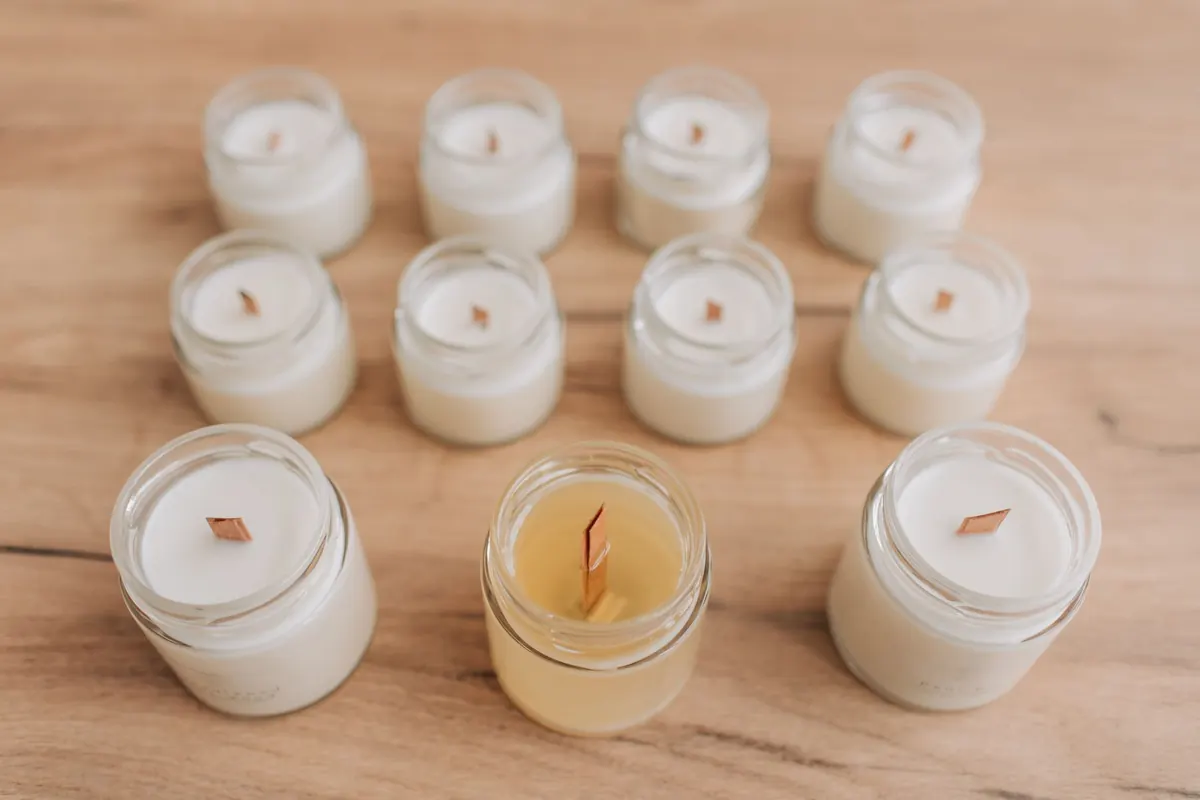
Wood wicks are thin strips of wood — ash and sapele are common — sometimes sold with a booster wick alongside for extra heat. They offer two things cotton cannot: an audible crackle and a wide, horizontal flame that spreads heat right across the surface of the wax.
That wide flame is also the limitation. Wood works best in open, wide containers; in a narrow jar or a tall pillar it can starve of oxygen and start to smoke. The strip needs priming in wax before the first burn, and trimming to roughly 3mm each time — leave it long and it will smoke, burn down the strip and blacken the glass. Dry wood snaps easily, so handle primed wicks gently.
Wood also asks more of your wax. It burns hot and broad, so it sits happily in soy, paraffin and soy-blend container candles, but it struggles in very hard, high-melt-point waxes and in candles pushed too hard on fragrance.
Hemp wicks: a cooler, smaller flame
Hemp wicks are braided hemp fibre, usually primed in wax and often sold as twine. They burn cooler than cotton, curl as they go — which means they largely self-trim — and give a smaller, calmer flame.
That cooler burn is both the selling point and the catch. In a soft soy or coconut-soy blend in a small jar, hemp works nicely. In a large container, a hard beeswax blend or a candle with a heavy scent load, it often cannot keep up: the flame sinks, the melt pool stalls, and you end up with tunnelling and eventually a drowned wick. Hemp is also the least consistent of the three, with fewer sizes on offer and often a higher price than cotton. If you are pairing it with beeswax, expect to go up a size or two.
Comparing the three at a glance
- Flame size: wood gives the widest, most horizontal flame; cotton sits in the middle with a steady teardrop; hemp is smallest and coolest.
- Crackle: wood only. Cotton and hemp are silent apart from the faint hiss of a wick that needs trimming.
- Trimming: cotton to about 5mm before every burn; wood to about 3mm; hemp curls and self-trims, but still benefits from a tidy-up every few burns.
- Cost and availability: cotton is cheapest with dozens of sizes; wood sits in the middle; hemp is usually dearest with the fewest options.
- Best suited to: cotton suits almost anything; wood suits wide containers and waxes you want to hear; hemp suits small jars, soft waxes and a gentler flame.
Matching wick to wax
Wick charts are a starting point, not a guarantee, because the same wax from two suppliers can behave differently. Still, some patterns hold.
Paraffin burns easily, so almost any wick works — and it often needs a size smaller than you would use in soy. Soy is denser and harder to melt, so it wants a larger wick; cotton and wood are the most predictable choices, with hemp better in smaller jars. Coconut blends can be soft yet slow to melt, so treat them as their own puzzle rather than assuming your soy sizing carries over. Beeswax has a high melt point and smokes easily; cotton tends to be the safest bet, and wood needs a wide mould to perform.
Fragrance and dye shift things too. A heavy scent load and a dark colour both make wax harder to burn, so a wick that worked in a plain pour may not cope with a rich one. Container diameter matters just as much: measure the widest point of the jar, not the neck, and allow extra for a draughty spot on a shelf.
Testing a new wick before you commit
- Pour three or four test candles, identical except for the wick — your guess, one size up, one size down.
- Let them cure for as long as your wax recommends; soy in particular needs a few days.
- Burn for three to four hours in a draught-free spot, without trimming mid-burn.
- Check the melt pool: it should reach the edge of the container within a few hours. A flame around 20–30mm tall is a good sign; soot on the glass or constant flickering is not.
- Trim, let it cool completely, then repeat for two or three more burns. The first burn can flatter a wick that fails later.
- Write down the wick type, size, wax, fragrance load and container diameter. That note is worth more than any chart.
Which should you use?
If you want one starting point, use cotton. It is cheap, widely available, forgiving and neutral, and it lets you learn your wax without fighting the wick. Build wood in as a feature once you are confident with sizing and have a wide enough container to give it air. Keep hemp for small, soft-wax candles where a cool, curling flame is what you want.
Then test every new combination — new wax, new fragrance, new jar — before you burn it in someone else's home, and never sell a candle you have not burned yourself from first light to last. If you plan to sell, check the current labelling and safety requirements that apply where you trade, and take proper advice rather than relying on a forum thread.
Photo: Vlada Karpovich / Pexels